
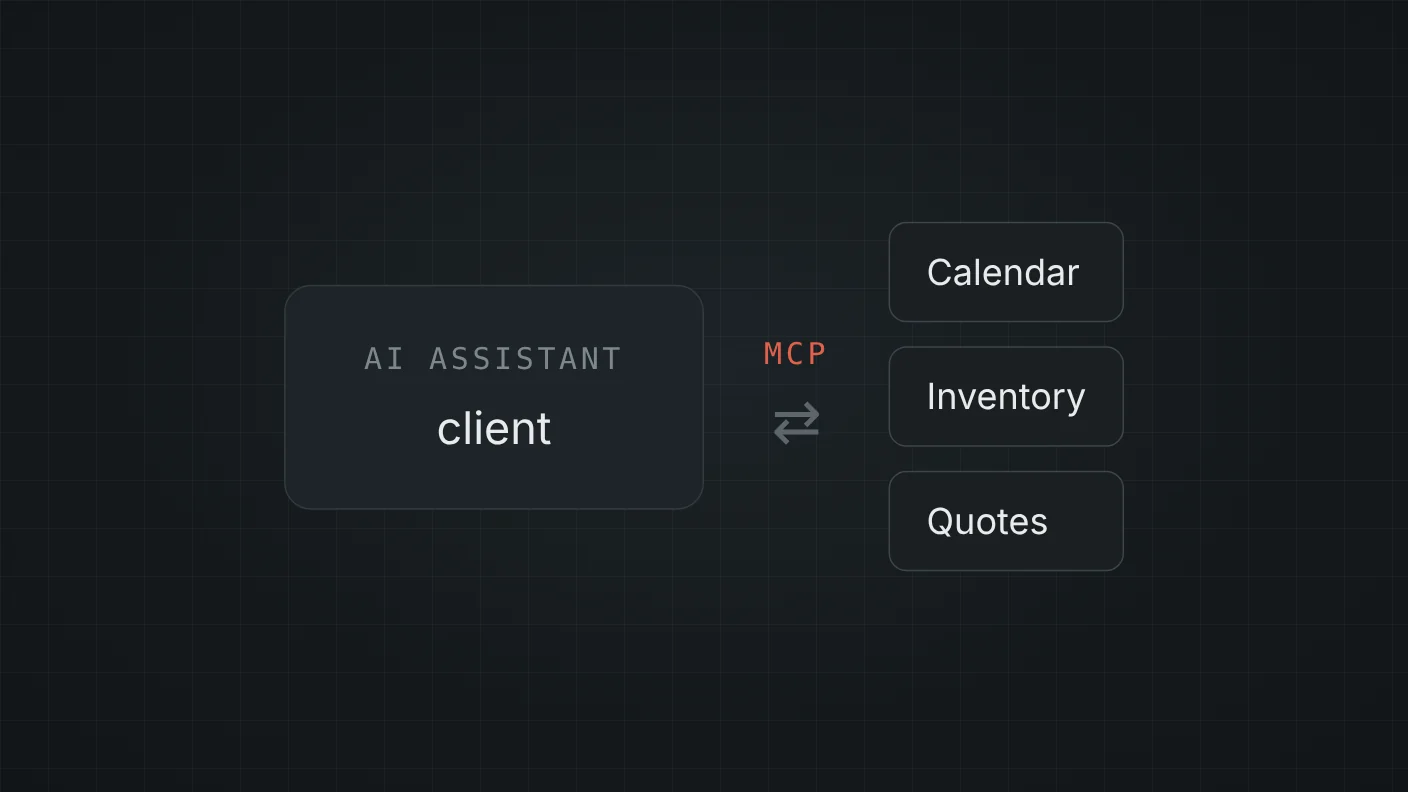
What MCP is, in one sentence
MCP, the Model Context Protocol, is an agreement on how an AI assistant asks another system for something and how that system answers. Think of USB: before it, every device had its own cable. With a standard, any device plugs into any computer.
On one side is the "client": ChatGPT, Claude, Gemini, Copilot. On the other is the "MCP server": a small program that exposes what your system allows, like "find a quote" or "check inventory".
Who supports it in 2026
Anthropic released it in late 2024. In December 2025 it was donated to the Agentic AI Foundation under the Linux Foundation, with OpenAI and Block as co-founders and Google, Microsoft and AWS as members. ChatGPT, Claude, Gemini, Copilot and the major code editors support it, and there are thousands of public servers.
In short: it's no longer one company's bet. It's how AI assistants connect, and it will be inside tools you use whether you see it or not.
What a small business can use it for
- Ask without opening the system. "How many October quotes are still unanswered?", in plain language.
- Let your team use AI with your data, not with what the AI guesses about your business.
- Connect once, use from several assistants. If you switch from one AI tool to another, the MCP server keeps working.
I use it daily in my own work, connecting assistants to local tools so they can look things up and run tasks I used to do by hand.
What it looks like in practice
Say you have a quoting tool with your quotes stored in it. With an MCP server connected, the conversation goes like this:
- You ask the assistant: "Which October quotes are still waiting for the customer's answer?"
- The assistant sees it has a tool called, say, "find quotes", and calls it with two filters: October and pending.
- Your system answers with the list. Only the list: the assistant sees nothing the server doesn't hand over.
- The assistant summarizes it and, if you ask, drafts a follow-up message for each customer. Sending it is still your call.
The key is step three: your system decides what it hands over. That's why the MCP server is the piece to design and test carefully.
What to ask anyone offering an MCP integration
- Which tools does the server expose, and which can change data?
- What customer data travels to the AI service, and to which one?
- Is every query and action logged?
- How do we switch it off if something goes wrong?
The risks, said out loud
An AI connected to your systems can do whatever the server allows. The risk isn't MCP itself. It's what gets exposed, and to whom.
- Too many permissions. A server that can delete or send, when reading was enough.
- Unreviewed third-party servers. In early 2026, dozens of vulnerabilities were reported in MCP servers, including instructions hidden in a tool's description to trick the AI.
- Customer data traveling to an outside service without anyone deciding it should.
The rule I apply: read-only first, with the minimum data. Writing or sending only after testing with real cases, with a log of every action.
Do you need it now?
Probably not yet if your business runs on WhatsApp and a spreadsheet. It makes sense once you have a system with organized data, like a quoting tool, an inventory or a calendar, and your team loses time looking things up in it. That's the same test as for AI automation: process first, technology second.