
What a small business website costs in 2026
Industry guides put a five to ten page small business site at roughly $1,500 to $5,000 with a freelancer and $5,000 to $15,000 with an agency. DIY builders cost a few hundred dollars a year in subscriptions plus your own time.
Mine is $600 to $900, fixed. It's lower for plain reasons: I work remote from Lima, I keep sites small and fast, and I don't sell you a platform you'll pay for monthly. What moves the price inside that range is the number of sections and connected forms, not hours.
What a fixed price should include
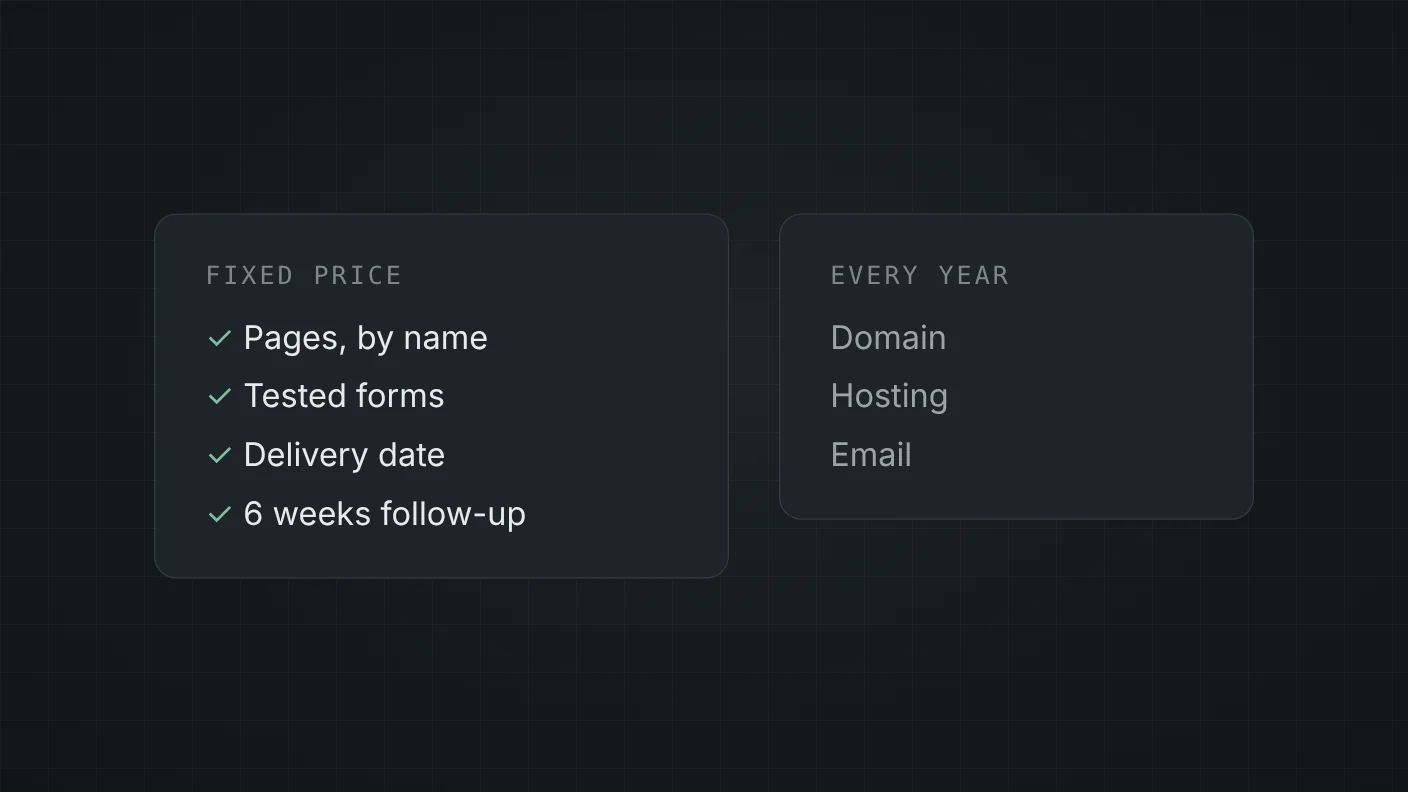
- The page list, by name. "Home, services, about, contact" is a scope. "A professional website" is not.
- Forms that are tested, with the address where messages arrive.
- Mobile first. Most visitors arrive on a phone.
- Basic search setup: titles, descriptions, a sitemap, structured data and Search Console.
- A delivery date that depends on when you send your texts, stated as such.
- A follow-up period where anything delivered that breaks gets fixed at no cost. Mine is six weeks.
- You own everything: domain, hosting account, code and Google accounts in your name.
What you pay every year, no matter who builds it
Domain renewal, hosting and email. For a small site that's often under $200 a year, sometimes much less. Ask for these numbers before you sign, so the first renewal isn't a surprise.
Red flags in a website quote
- The domain is registered in their name. If the relationship ends, your address goes with them.
- "Unlimited revisions." It sounds generous and usually means nobody defined the scope.
- A monthly fee to keep the site online that's higher than hosting costs, with no maintenance listed.
- No mention of testing. A site nobody tested on a phone before launch is a site with a broken form waiting to happen.
How the process works
- A conversation or an audit. If you have a site, I start by testing it. If you don't, we talk for half an hour about what the business needs.
- A written proposal. Scope, price and date. What isn't in the proposal doesn't appear on the invoice later.
- Weekly progress you can see, on a private link, not a presentation at the end.
- Testing before delivery, on a phone and a laptop, with real data in the forms.
- Six weeks of follow-up. If something delivered fails in that time, I fix it at no cost.
Five questions to ask before you sign
- Whose name will the domain and hosting be in?
- What happens if I need one more page after we start?
- Who writes the text, and who chooses the photos?
- How do you test the site before launch?
- What does it cost me per year after the first one?
A good builder answers all five in one email. If the answers are vague, the invoice will be too.
Bilingual, if your customers are
If part of your customers prefer Spanish, a bilingual site is often the cheapest way to stand out locally. Spanish pages need their own titles and descriptions to show up in Spanish searches, not just translated text. I build sites in English, Spanish or both, with each language set up for its own searches.
When you don't need a new website
If you already have one and it looks fine, test it first. The website audit often finds three fixes that cost less than starting over. A rebuild makes sense when the foundation is the problem, not when one form stopped sending.